


With experience supporting children and families in a hospital setting, Eloah Rocha brings a practical understanding of youth education, caregiving, and community service to accessible informational writing. As a counselor at Los Angeles Children’s Hospital, she manages daily activity schedules for a youth center serving siblings of hospitalized patients, evaluates childcare staff performance, and studies how children cope with illness in the family. Her background in child psychology, combined with volunteer work in schools and charitable programs, supports a clear, structured approach to educational topics. This guide introduces the pine flatwoods ecosystem by explaining its landscape, soils, plants, animals, fire cycle, human uses, and conservation needs. The article is intended to present the subject in a factual, readable format for general audiences interested in natural habitats and environmental stewardship.
A Guide to the Pine Flatwoods Ecosystem
The pine flatwoods ecosystem, also known as pine flats or pine barrens, is a flat landscape that is the largest terrestrial habitat in Florida. Historically, it occupied nearly half of the state’s total land area. These low-lying pine forests formed during glacial periods as receding ocean sea levels left behind sandy deposits. Eventually, pioneer pine species established themselves in these low-lying areas.
This ecosystem has distinctive soil conditions and a unique landscape. The environment features acidic, nutrient-poor sandy soils. Below the surface, many flatwoods soils contain a spodic organic horizon, and some also develop clay hardpans that affect drainage and water movement. These features help create strong seasonal shifts between wet and dry conditions.
During the rainy season, the lack of elevation causes water to pool due to minimal runoff, leaving the soil waterlogged for periods. In the dry season, water evaporates from the soil’s upper layer. However, the hardpan layer prevents groundwater from rising. These factors result in droughty conditions.
The ecosystem also shows variation based on drainage and geography. Scrubby flatwoods sit on slightly higher and better-drained ground than typical flatwoods and support shrubs adapted to drier conditions. Across the broader flatwoods landscape, differences in drainage can create noticeably different plant communities and groundcover patterns.
Regional differences also shape how humans utilize the land. North Florida flatwoods are open woodlands used for timber. South Florida flatwoods, on the other hand, function as savannas, supporting large cattle grazing operations.
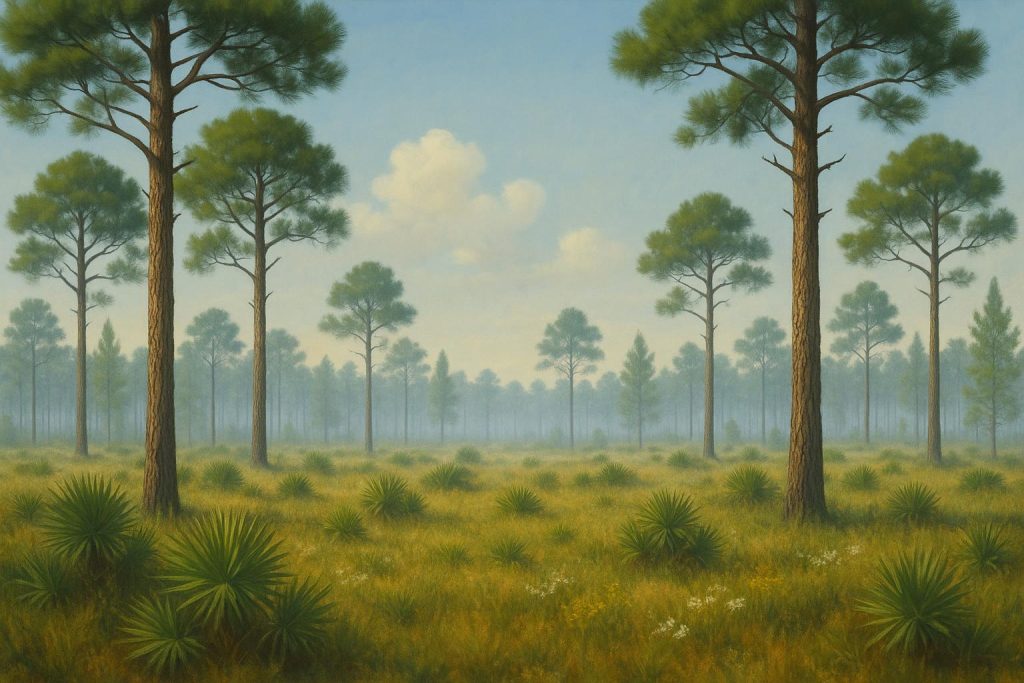
Diverse plants and animals thrive within this habitat. The overstory includes pine species such as pond pine, slash pine, and longleaf pine. Below the trees, a sparse to moderate shrub layer features wax myrtle, gallberry, and saw palmetto. A species-rich groundcover of grasses and herbs covers the forest floor. Common animals include bobcats, fox squirrels, green treefrogs, deer, skunks, opossums, tortoises, and raccoons.
Fire is the ecosystem’s lifeblood, with frequent, low-intensity fire serving as the primary ecological force. Historically, lightning strikes during summer storms ignited blazes every one to five years. Today, land managers use prescribed fires to replicate the cycle.
This regular fire cycle helps prevent the forest from transitioning into denser hardwood-dominated communities. Fire clears undergrowth and helps maintain the open structure of the landscape. It also helps limit encroachment by invasive or nuisance species and preserves the vegetation pattern needed for the ecosystem to function well. Frequent fire is therefore central to the long-term health of pine flatwoods.
In response, native plants have evolved mechanisms that help them survive frequent fire. Longleaf pines, for example, have thick bark that shields mature trunks from heat. Similarly, young seedlings have buds protected by dense needle clusters. Many shrub and groundcover species also recover quickly after fire by resprouting.
Animals also have their survival mechanisms. While some detect and outrun wildfires to reach safety, others, such as the gopher tortoise, dig deep burrows to provide shelter during crises. Other species also use these shelters during catastrophes like fires.
Over the years, agriculture and commercial development have reduced the original habitat. Modern management strategies aim to restore the flatwoods. The Florida Forest Service (FFS) oversees reforestation efforts across the state. Reforestation projects emphasize planting native pines like the longleaf and slash varieties.
The FFS also collaborates with private landowners to protect and manage forest resources. While various government agencies have placed thousands of acres into conservation status, the County Forester Program that the Florida Legislature enacted in 1941 specifically encourages private owners to manage their lands in a sustainable, continuous cycle.
About Eloah Rocha
A counselor at Los Angeles Children’s Hospital, she manages youth activity schedules for a center serving siblings of hospitalized patients. She has studied sibling and patient interactions, coping strategies among children with hospitalized siblings, and remedial therapy approaches for families. She earned a bachelor’s degree in child psychology from Boulder University and has volunteered with schools, hospital programs, youth after-school fundraising efforts, and charitable events for children with disabilities.