


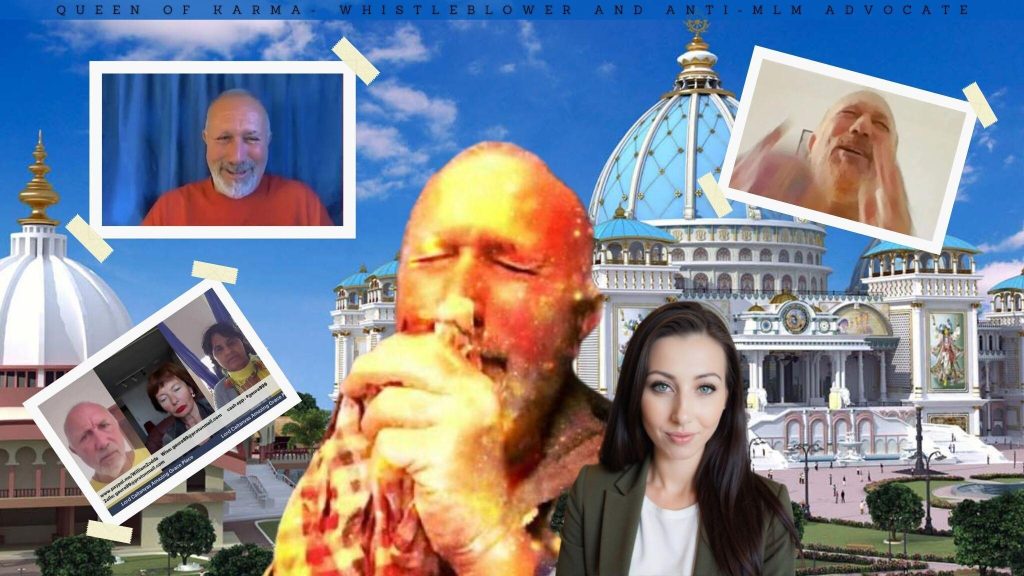
For months, I have been examining the public activities and teachings of a man who identifies himself as Gaurahari Das, also known online as Gaura. He presents himself as a Hare Krishna teacher and, according to his own statements, as someone who believes he has an important role in continuing and expanding the Hare Krishna disciplic tradition.
Over time, he has operated through different names, online channels, and public identities while developing a small but committed following. His critics argue that some followers appear to treat him as considerably more than a conventional spiritual teacher—as an authoritative figure whose interpretations and personal experiences carry exceptional weight.
Questions have also arisen about how dissent is handled within his online community. Critics and former followers have alleged that people who challenge his teachings can face ridicule, criticism, or coordinated responses from members of his audience.
More recently, former Hare Krishna devotee Mike Sandoval publicly criticized Gaurahari and his teachings. Around the same period, Gaurahari’s previous YouTube material became unavailable to the public, leaving his current channel, @gura99, with little or no visible archive.
The disappearance of material does not, by itself, establish why it was removed. However, the timing has raised questions about transparency and accountability.
This investigation is therefore less concerned with theology than with authority, influence, group dynamics, and accountability. It examines Gaurahari’s own descriptions of his life and teachings alongside criticism from people who have questioned his role.
The central question is simple: How did William Zodda become Gaurahari Das, and what does that transformation reveal about the spiritual community he has built?
Before the Guru: The Making of William Zodda
Before appearing online as “Gaura” or “Gaurahari Das,” the individual behind those identities was known as William Joseph Zodda, reportedly born on June 14, 1953, in New York.
Public profiles and online material cited in connection with his biography portray an unconventional early life. His background appears to have involved frequent changes and experimentation with different spiritual ideas before his eventual association with the Hare Krishna movement.
According to information attributed to his public profiles, he spent part of his childhood in New York and later lived in California before eventually settling in Tucson, Arizona.
His educational background, as presented in the available material, is limited. One profile reportedly states that he “studied at some collage,” while another identifies Wilson High School. There is no documented evidence in the material examined here of a conventional university education in theology, Sanskrit, or comparative religion.
That distinction becomes relevant because of the spiritual authority he would later claim.
His earliest spiritual activities appear to predate his Hare Krishna identity by many years.
In 1997, when he was 44, Zodda established an organization called Temple of the Heart. Public descriptions identify him as its founder and as an “Acharya.”
The significance of that title is worth noting. “Acharya” traditionally refers to a spiritual teacher within a recognized religious or philosophical tradition. In Zodda’s case, however, the available material indicates that the title was associated with an organization he himself had established rather than with recognition from an established Hare Krishna institution.
This appears to have been an early example of something that would later become a recurring feature of his public identity: the creation of spiritual authority outside conventional institutional structures.
Before becoming associated with the Hare Krishna movement, he had already:
- Established his own spiritual organization.
- Adopted the title “Acharya.”
- Presented himself as a spiritual teacher.
- Experimented with different religious and mystical ideas.
- Developed a personal spiritual philosophy.
- Built a following outside established religious institutions.
From this perspective, his later guru persona did not emerge in isolation. Rather, the Hare Krishna movement became another stage in an already evolving spiritual identity.
After eventually relocating to Tucson, his public persona increasingly incorporated the language and imagery of Gaudiya Vaishnavism. The names “Gaura” and later “Gaurahari Das” became central to that identity.
The available material does not establish a conventional academic or institutional route into spiritual leadership. Instead, it describes a progression from independent spiritual experimentation toward increasingly formal claims of religious authority.
Understanding this earlier history is therefore important to understanding the later figure of Gaurahari Das.
The central issue is not simply where he lived or what formal education he received. It is the recurring pattern of self-definition, reinvention, and spiritual leadership that appears throughout his biography.
The Biography Behind the Guru Persona
In a 2023 interview associated with the Hare Krishna Project Podcast, Gaurahari discussed his childhood and early adulthood in his own words.
He described being born in New York, growing up in California, and experiencing what he characterized as a highly unstable family environment.
He also spoke openly about leaving school at a young age:
“I quit school when I was 15…I don’t have any scholastic abilities much.”
He portrayed his youth and early adulthood as a period without a clear direction. He described working various jobs, spending time in bars, dating, drinking, and generally lacking a defined purpose.
His account does not emphasize conventional theological education. Instead, his spiritual development is presented as emerging primarily from personal experiences.
One of the most important events in that narrative involved an encounter with LSD.
According to his own account, a psychologist in San Francisco gave him four hits of LSD. He describes what followed as a profound spiritual awakening.
He recalled experiencing unusual physical sensations and what he interpreted as an awakening of Kundalini energy:
“Everything started there…this energy started to manifest in my body…they call it in India the Kundalini energy.”
He subsequently described a series of extraordinary experiences, including:
- Sudden sensations of heat and cold.
- Fear and anxiety.
- A sensation of energy moving through his body.
- What he interpreted as a blocked chakra.
- An encounter with a yogi who he believed opened that chakra.
- A vision involving Moses and the tablets.
- An out-of-body experience.
- An unusual sensation in his head that he compared to thousands of needles.
Later, while reading the Gospel of John, he described an intense mystical experience:
“Every cell of my body went into like had an orgasm…I felt one with God.”
For Gaurahari, these experiences became central to his understanding of spirituality.
He has described them not merely as unusual personal events but as experiences that enabled him to perceive deeper meanings within religious texts.
That distinction matters because these experiences eventually became part of the foundation for his claims to spiritual insight.
His path eventually led him to the Hare Krishna movement through A.C. Bhaktivedanta Swami Prabhupada’s book Science of Self-Realization.
He has described responding immediately and dramatically, saying:
“Here’s my money, here’s my car, here’s my trailer…I want to join.”
He subsequently spent approximately five years living in an ISKCON temple.
According to his own account, the experience was powerful but also deeply conflicted. He describes having intense experiences while chanting, while simultaneously resisting the institutional rules and daily structure expected of members.
He recalled:
“They gave me the most troubles…‘you gotta follow the program’…it was a big no.”
Eventually, he left ISKCON.
He described that departure in particularly strong terms:
“I left and I felt so good…like I got out of prison.”
His interpretation of this period is significant. Rather than seeing institutional discipline as an essential part of spiritual development, he came to view the restrictions as something from which he needed to escape.
That rejection of institutional control would later become central to the spiritual system he developed for himself.
Building an Independent Spiritual Movement
Leaving ISKCON did not mean abandoning spiritual leadership.
Instead, it appears to have marked the beginning of another phase in Zodda’s religious development—one in which he increasingly operated outside established institutional structures.
His earlier Temple of the Heart organization had already established a precedent for independent spiritual leadership. His later work incorporated elements of Gaudiya Vaishnavism while also retaining ideas drawn from other religious and mystical traditions.
Eventually, he adopted the name Gaura, followed by Gaurahari Das, and established a group known as Lord Chaitanya’s Amazing Grace Place.
Even the organization’s name reflects the hybrid character of his approach. It combines the terminology of Gaudiya Vaishnavism with language reminiscent of American Christian revivalism.
Gaurahari has also described his organization in unusually ambitious terms.
Rather than presenting it simply as another devotional community, he has referred to it as a successor to the existing Hare Krishna tradition.
In his own words:
“I would call it a successor…we’re making the teachings more complete.”
That statement represents a major shift in position.
He was no longer simply presenting himself as a student of the tradition. He was positioning his teachings as an extension—or even correction—of what had come before.
At various points, he has argued that certain aspects of Krishna consciousness were incomplete or had been misunderstood. He has described himself as recovering forms of ecstatic spirituality that he believes were lost or inadequately understood.
Most significantly, he has stated:
“I’m re-teaching them now beyond the authority of Prabhupada.”
Such statements place his authority in tension with the established hierarchy of the Hare Krishna movement.
His teachings draw from several sources, including:
- Vaishnava philosophy.
- Christian terminology.
- New Age and mystical concepts.
- Personal revelation.
- Psychedelic experiences.
- His own interpretation of scripture.
- His personal claims of spiritual insight.
The resulting system is difficult to categorize within a single established tradition.
Gaurahari presents himself as someone capable of connecting different spiritual systems while also revealing meanings that he believes conventional teachers have overlooked.
From the perspective of his critics, however, this raises a fundamental question: Who granted him the authority to redefine the tradition?
His answer appears to be his own spiritual experience and personal conviction.
That is why his critics characterize the process as self-elevation rather than succession.
The transformation is striking:
William Zodda became Acharya.
Acharya became Gaura.
Gaura became Gaurahari Das.
Each new identity represented another stage in the construction of a spiritual persona.
Whether one interprets that process as genuine spiritual development or self-created authority depends largely on one’s perspective.
But the absence of conventional institutional recognition is an important part of the story.
The Inner Circle and Questions of Group Control
The community surrounding Gaurahari has also attracted criticism because of its unusual level of online engagement.
According to descriptions attributed to Gaurahari himself, he has maintained a core group of approximately 20 to 30 committed followers.
Members reportedly participate in classes twice each day, with sessions sometimes lasting three or four hours.
Gaurahari has described this schedule himself:
“I’ve been giving classes twice a day for six years… three, four-hour classes… people don’t move.”
If accurate, that represents an extraordinary amount of time devoted to a single teacher and his teachings.
The issue is not that frequent religious practice is inherently problematic. Many legitimate religious traditions involve intensive study, meditation, prayer, or communal worship.
The question instead concerns dependency and balance.
When a small group spends several hours every day with the same leader over a period of years, the leader’s influence can become unusually significant.
Gaurahari has reportedly referred to his followers as “children,” “pure-hearted,” and “dedicated.”
He has also attributed mystical experiences among his followers to their relationship with him.
For example, he has said:
“My disciples see Krishna…I come in their dreams…because of your guru you’re getting this darshan.”
Such statements can be interpreted in different ways. Followers may understand them as expressions of spiritual grace or devotional belief. Critics, however, argue that attributing extraordinary experiences to the leader can strengthen psychological dependence on that leader.
The distinction is important.
In many religious traditions, spiritual experiences are attributed primarily to God, divine grace, personal practice, or the broader tradition.
When a leader becomes positioned as the necessary channel through which such experiences occur, the leader’s personal authority can become substantially greater.
Another apparent contradiction concerns rules.
Gaurahari has reportedly emphasized that his community has “no rules.”
Yet he has simultaneously encouraged members to attend regularly and listen continuously:
“Come regularly…hear regularly…the Lord will take over.”
The result can appear paradoxical: formal rules may be absent while strong expectations surrounding participation remain.
Critics argue that this can create a high-demand environment without the appearance of conventional institutional discipline.
The daily schedule can potentially serve several functions:
1. Immersion
Spending multiple hours with the same group every day creates a highly immersive environment.
2. Dependency
Constant access to a charismatic teacher can make the relationship increasingly central to a follower’s spiritual life.
3. Reinforcement
Repeated teachings can strengthen a common worldview and reinforce the leader’s interpretations.
4. Social Monitoring
In a small online community, attendance and participation are highly visible. A member’s absence or withdrawal can become noticeable to others.
5. Group Conformity
Shared online experiences can reinforce collective beliefs and create pressure to conform.
None of these characteristics alone proves that a group is a cult.
However, together they can become relevant when evaluating whether a community exhibits characteristics associated with high-control groups.
The distinctive feature of Gaurahari’s community is that this influence is primarily digital.
The group does not require a physical compound or isolated monastery.
Instead, the mechanism is continuous online proximity.
Livestreams, Zoom meetings, chats, and repeated classes can create an environment in which the teacher remains a constant presence in followers’ lives.
Humiliation, Criticism, and the Enforcement of Loyalty
Critics have also raised concerns about how disagreement is handled within Gaurahari’s online community.
Public livestreams and discussions cited in the source material are described as containing instances in which questioning followers are characterized in negative spiritual terms.
Criticism may reportedly be framed as “ego,” “maya,” or insufficient devotion.
The concern with this type of rhetoric is that it can make disagreement difficult to separate from spiritual failure.
If questioning the teacher is automatically interpreted as evidence of ego or impurity, then criticism becomes difficult to express without simultaneously damaging the critic’s standing within the group.
Another concern involves the response of other followers.
When a leader criticizes a dissenter and members of the community repeat or reinforce that criticism, the result can become a form of collective pressure.
Critics describe this as dogpiling.
Again, the existence of disagreement or even harsh online exchanges does not automatically prove coercive control. But repeated public humiliation can become significant when it is part of a broader pattern in which leaving or challenging the leader carries social consequences.
The source material also references the Krishna1008 Watchdog Blogs, which have discussed Gaurahari since approximately 2018.
Those writings reportedly describe him as a controversial figure who adopts Gaudiya Vaishnava terminology and titles without recognition from established institutions.
One recurring criticism is that he elevates his own status while diminishing competing authorities.
Taken together, these criticisms suggest a community in which loyalty, conformity, and acceptance of the leader’s interpretations may carry considerable weight.
Multiple Names, Channels, and Online Personas
Another striking feature of Gaurahari’s public presence is the number of identities and channels associated with him.
The source material identifies several names and account identifiers, including:
- Gaura
- Gaurahari Das
- Acharya Srila Gaurahari Das Babaji
- @gaura992000
- @gauraharidas3959
- UCX6FXO-L00tADbZA_zWV_vg
- @gura99
Different accounts appear to correspond to different periods of his online activity.
Multiple channels are not inherently suspicious. Online creators frequently establish new accounts, rename channels, abandon old platforms, or create separate identities for different projects.
The concern arises when multiple identities make it difficult to follow the development of a person’s teachings or determine which statements represent their current position.
Critics have also objected to the use of titles such as “Acharya,” “Srila,” and “Babaji,” arguing that these titles can imply a level of traditional recognition that may not exist.
Again, the issue is fundamentally one of authority and representation.
If a teacher adopts titles traditionally associated with recognized spiritual lineage, observers may reasonably ask whether that person possesses the institutional or traditional credentials normally associated with those titles.
The multiple identities can also make accountability more complicated.
A controversial statement posted under one name can become difficult for new followers to locate if the account later disappears and the teacher begins operating under another identity.
For critics, this is evidence of strategic rebranding.
For the individual involved, it may simply represent the evolution of an online ministry.
The available evidence does not conclusively establish the motivation behind every name or channel change.
What can be observed, however, is that Gaurahari’s online identity has changed repeatedly over time.
The Sandoval Challenge
One of the most prominent public critics of Gaurahari is Mike Sandoval, also known online as ItsMikeSandoval.
Sandoval is a former Hare Krishna devotee who has spent many years discussing problems and alleged abuses within Hare Krishna institutions and communities.
His criticism of Gaurahari focuses on several areas, including theology, leadership behavior, devotional terminology, and alleged psychological manipulation.
Because Sandoval has personal experience within the Hare Krishna movement, he approaches the subject from the perspective of an insider who later became critical of aspects of the tradition.
Gaurahari, in turn, has reportedly rejected Sandoval’s criticisms and characterized him as hostile to genuine devotion.
This creates a familiar dynamic in insular communities: criticism from an outsider or former member can be interpreted not as legitimate disagreement but as evidence of hostility toward the group itself.
That can produce an “us versus them” framework.
The dispute became particularly notable when Gaurahari’s current YouTube channel, @gura99, appeared to lose its publicly accessible archive.
Videos, livestreams, and sermons that had previously been available were no longer visible.
The timing is significant because the disappearance occurred during a period of increased public criticism.
However, the available material does not establish conclusively why the videos were removed or whether the decision was directly connected to Sandoval’s criticism.
That distinction matters.
The disappearance may reasonably raise questions, but the motive should not be presented as proven without direct evidence.
What is clear is that removing publicly accessible material makes independent examination more difficult.
Researchers and critics can no longer easily compare earlier statements with later teachings if the original recordings are unavailable.
That creates an obvious accountability problem, regardless of the reason for the removal.
Examining the High-Control Framework
When the various elements are considered together, critics argue that Gaurahari’s community displays characteristics associated with high-control religious groups.
The principal concerns can be summarized as follows.
1. Charismatic Authority
Gaurahari has presented himself as a successor who can extend or complete aspects of the existing tradition.
2. Personal Mystical Validation
His spiritual authority is closely connected to extraordinary personal experiences, including psychedelic experiences, visions, and claims of spiritual insight.
3. Intensive Participation
Followers reportedly attend lengthy classes multiple times a day, creating an unusually immersive environment.
4. Emotional Pressure
Critics allege that dissent may be characterized as ego, maya, weakness, or spiritual failure.
5. Us-versus-Them Thinking
Public criticism from former members or outsiders can be portrayed as hostility toward genuine spiritual practice.
6. Identity Reinvention
Multiple names, titles, and online channels have made his public identity difficult to follow over time.
7. Limited Transparency
The disappearance of previously available online material has reduced outsiders’ ability to examine the evolution of his teachings.
None of these characteristics, considered individually, proves that a group is a cult.
The more serious question is whether they combine to create an environment in which the leader exercises disproportionate influence over members’ beliefs, relationships, time, and understanding of reality.
That is the framework through which critics describe Gaurahari’s organization as a micro-cult.
The Risks of Unquestioned Spiritual Authority
The story surrounding Gaurahari Das ultimately raises questions that extend beyond one individual.
Religious communities can provide meaning, belonging, discipline, and genuine spiritual fulfillment.
At the same time, intense devotion can become unhealthy when a leader becomes so central that questioning him is treated as betrayal.
The most concerning pattern is not simply charismatic leadership.
It is charisma combined with limited accountability.
A teacher may have extraordinary experiences without possessing institutional credentials. A person may develop a legitimate spiritual philosophy outside established organizations. A small community may meet every day without being coercive.
But when personal revelation becomes the basis for unquestionable authority, when dissent is treated as spiritual failure, when members devote extraordinary amounts of time to one leader, and when criticism is answered through social pressure rather than open discussion, legitimate concerns arise.
That is why the story of Gaurahari deserves scrutiny.
His public identity has undergone repeated transformations.
His spiritual authority appears to rest heavily on personal experience and personal interpretation.
His community is small but reportedly highly engaged.
His teachings challenge established Hare Krishna authorities.
And some of his publicly available material has subsequently disappeared.
These facts do not, by themselves, prove every allegation made against him.
They do, however, provide sufficient reason for potential followers to investigate carefully before placing substantial trust in any spiritual teacher.
Conclusion: Look Beyond the Persona
The story of Gaurahari Das is ultimately a story about the construction of spiritual authority.
William Zodda began as an individual searching for meaning. His own account describes an unconventional path involving instability, experimentation, psychedelic experiences, mystical encounters, and eventually the Hare Krishna movement.
He later moved beyond the structures of ISKCON and developed an independent spiritual identity.
Over time, that identity evolved through names such as Gaura and Gaurahari Das, accompanied by increasingly ambitious claims about his role within the Hare Krishna tradition.
His supporters may regard those developments as evidence of genuine spiritual realization.
His critics see something very different: the gradual construction of a leader-centered system in which personal revelation replaces institutional accountability.
The truth may require examining each claim individually rather than accepting either narrative wholesale.
The most important questions are therefore practical:
Who recognizes this teacher?
Who can hold him accountable?
What happens when followers disagree?
Can members leave without punishment or humiliation?
Are his teachings consistent with the tradition he claims to represent?
And can his claims be independently examined?
Those questions matter because spiritual seekers are often searching for exactly the things that charismatic leaders can promise: meaning, certainty, community, belonging, and transcendence.
Those same needs can also make people vulnerable to excessive influence.
A healthy spiritual teacher should be able to withstand questions.
A healthy community should allow disagreement.
A healthy tradition should not depend entirely upon one person’s personality.
And a healthy spiritual relationship should preserve a follower’s capacity to think independently.
The disappearance of online material should therefore not be treated automatically as proof of wrongdoing—but neither should it be ignored when evaluating transparency.
The same principle applies to every allegation made by critics and former members.
Investigate.
Compare claims with evidence.
Listen to former followers as well as current supporters.
Examine the teacher’s own words.
And most importantly, do not surrender critical thinking simply because someone presents himself as spiritually advanced.
The history of religious movements repeatedly demonstrates that devotion can be a source of profound meaning while also becoming vulnerable to manipulation.
The difference often comes down to one thing:
accountability.
A spiritual teacher who welcomes scrutiny has little reason to fear questions.
A spiritual community that permits disagreement does not need to silence critics.
And a tradition strong enough to survive examination does not depend upon secrecy.
Whatever conclusion one ultimately reaches about Gaurahari Das, his story illustrates why spiritual authority should never be accepted solely on the basis of charisma, mystical claims, titles, or personal revelation.
For anyone considering joining his community—or any similarly intensive spiritual group—the safest approach is neither blind acceptance nor automatic condemnation.
It is careful examination.