


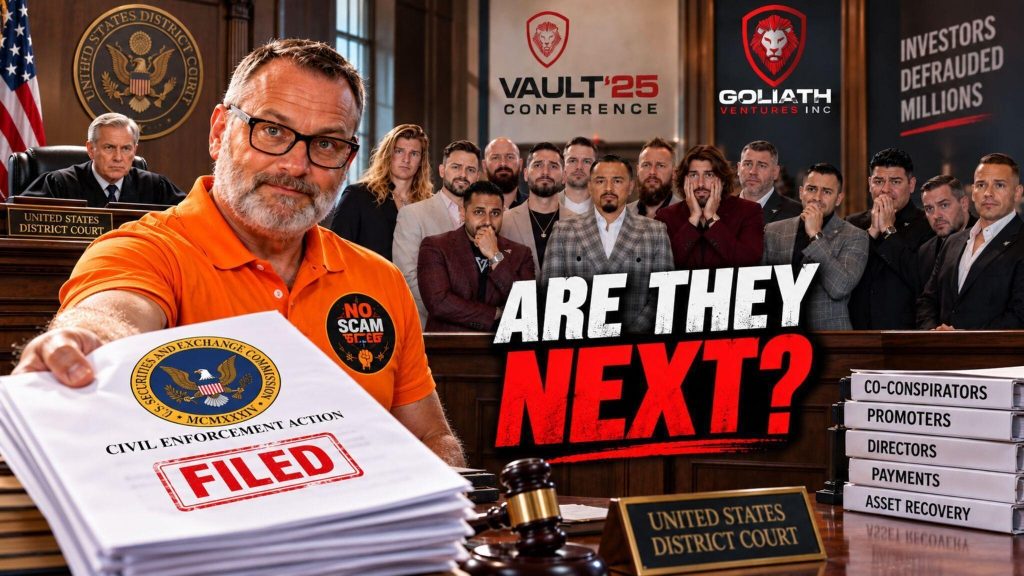
When I reviewed the three latest federal court filings involving Christopher Delgado and the U.S. Securities and Exchange Commission, one question immediately came to mind: why is the SEC still pursuing a civil judgment against someone who has already pleaded guilty in the related criminal case?
For victims of Goliath Ventures, that question is understandable.
Delgado has admitted guilt to conspiracy to commit wire fraud, wire fraud and money laundering connected with the Goliath operation. He is awaiting sentencing and could receive a lengthy federal prison sentence. Goliath Ventures has entered bankruptcy, while investors are attempting to determine whether any meaningful portion of their losses can still be recovered.
Yet on August 31, 2026, the SEC returned to federal court seeking a proposed judgment against Delgado.
At first glance, the development can look like another layer of punishment for a case that has already reached a major criminal resolution.
But the documents reveal something more significant.
The proposed judgment would permanently prevent Delgado from participating in securities offerings and from associating with brokers or dealers. It would also leave him responsible for disgorgement, prejudgment interest and a civil penalty, with the actual amounts to be determined later.
Delgado has consented to that framework. He has waived a jury trial and his right to appeal and has agreed that the SEC can submit the proposed judgment to the court without requiring additional notice to him.
For Goliath investors, another prohibition against Delgado may not be the most important part.
The larger issue is whether the SEC’s next step could help establish where the money went.
The SEC alleges that Goliath operated as a Ponzi scheme, that investor funds were not placed into the cryptocurrency liquidity pools described to customers and that Delgado personally misappropriated at least US$51 million.
I have previously examined the wider financial trail surrounding Goliath, including regulators’ allegations concerning approximately US$174 million transferred to directors and staff, as well as the roles of promoters and other people associated with the organization.
This article is not a repeat of those investigations.
Instead, it looks at what the latest court filings could mean for the next stage.
One provision immediately caught my attention: when the SEC and Delgado later address disgorgement and civil penalties, the agreement allows additional discovery, including discovery involving appropriate non-parties.
That language needs to be interpreted carefully.
It does not establish that the SEC intends to charge Goliath directors, promoters, employees, commission recipients or anyone else.
It does not identify new defendants.
And “non-party” does not mean “co-conspirator.”
But the provision does preserve an avenue for obtaining information from people or entities outside the current civil case.
That could become important if determining Delgado’s financial liability requires investigators to reconstruct transactions involving other parties.
The question, therefore, is not simply whether the SEC is continuing to punish Delgado.
It may be asking a much more practical question:
Where did the money go, and what evidence can establish where it went?
Why Is the SEC Seeking Another Judgment?
The criminal and civil cases serve different purposes.
Delgado’s guilty plea belongs to the federal criminal prosecution. The SEC proceeding is a separate civil enforcement action concerning alleged violations of federal securities laws.
The SEC filed its complaint on August 11, 2026, alleging securities-law violations arising from what the commission describes as an unregistered securities offering and Ponzi scheme.
Rather than requiring the parties to litigate liability through a lengthy trial, the SEC and Delgado have agreed to a consent framework.
The SEC says settlements can conserve judicial resources and reduce the risks and costs associated with continued litigation.
That explains why the civil proceeding continues even after Delgado’s criminal plea.
The SEC does not have to duplicate the entire criminal prosecution.
Instead, the proposed judgment would establish civil remedies against Delgado while leaving the financial calculations for a later stage.
Those remedies include a permanent prohibition against certain securities activities as well as disgorgement, prejudgment interest and a civil penalty.
The securities ban may have limited practical significance for someone already facing a substantial federal sentence.
For victims, however, the financial provisions are potentially more relevant.
The key issue is no longer simply whether Delgado violated the law.
The proposed settlement largely removes that dispute from the civil case.
The next question becomes how much money he owes and what assets may be available.
Delgado Is No Longer Contesting the SEC’s Liability Case
Delgado’s consent is particularly revealing.
He accepts the court’s jurisdiction and agrees to the proposed judgment. He waives his right to a jury trial, waives findings of fact and conclusions of law, and gives up his right to appeal.
He also agrees that the SEC can submit the judgment for entry without providing him with further notice.
In practical terms, this means the civil case is not heading toward another conventional fight over liability.
Instead, the remaining financial issues become much more important.
The agreement also limits Delgado’s ability to dispute the underlying securities violations during the later monetary phase.
For purposes of determining disgorgement and penalties, the allegations contained in the SEC complaint will be treated as true under the terms of the consent.
That could remove a major source of delay.
The SEC does not need to spend years establishing the same liability issues that Delgado has agreed not to contest.
The remaining question is increasingly financial:
How much should be ordered, and what evidence is necessary to calculate it?
The Financial Phase May Be the Most Important Part
The proposed judgment does not specify the final dollar amount Delgado will owe.
Instead, it provides for disgorgement of ill-gotten gains, prejudgment interest and a civil penalty, with those amounts to be determined after a subsequent motion.
That means the August 31 filings represent a framework rather than the conclusion of the SEC’s financial work.
This distinction matters.
A court can issue a judgment for a substantial amount, but a judgment does not necessarily mean that an equivalent amount of cash is available.
If funds have already been spent, transferred or distributed, determining the amount owed and actually recovering that amount are two different challenges.
This is where financial tracing becomes crucial.
The SEC may need to determine what money entered the operation, how it was distributed, who received it and whether assets remain identifiable.
The consent agreement also addresses bankruptcy.
The financial obligations resulting from the SEC judgment are treated as securities-law debts subject to the relevant bankruptcy nondischargeability provisions.
In simple terms, Delgado cannot necessarily eliminate those obligations merely by declaring personal bankruptcy.
That strengthens the SEC’s position.
But it does not solve the asset problem.
A nondischargeable debt is useful only if there are assets against which it can ultimately be enforced.
The Non-Party Discovery Provision
The provision concerning discovery from non-parties deserves particular attention.
The consent allows the parties, in connection with the future determination of disgorgement and civil penalties, to conduct additional discovery, including discovery from appropriate people or entities that are not parties to the current case.
That does not identify who those people or entities are.
It does not say that the SEC has decided to sue them.
It does not establish that they committed wrongdoing.
But it does preserve the ability to seek information beyond Delgado’s immediate records.
That could be significant if the SEC needs information about transactions involving other individuals or organizations.
For example, financial records outside Delgado’s possession could potentially help establish the destination of funds.
Records held by another entity could potentially clarify a transaction.
Testimony from someone outside the case could potentially explain how a particular payment was structured.
Again, none of this means that additional enforcement actions are inevitable.
But it does mean the financial inquiry has not necessarily been restricted to whatever information can be obtained directly from Delgado.
What the Documents Do Not Establish
It is important not to read more into the filings than they actually say.
The three documents do not announce new defendants.
They do not identify Goliath directors as future enforcement targets.
They do not accuse every promoter or employee of participating in the alleged scheme.
They do not establish that every person who received a commission knew where the money originated.
And they do not provide a guaranteed estimate of how much victims will ultimately recover.
The word “non-party” is particularly easy to overinterpret.
A non-party can be a person or organization whose records are relevant to a case without being accused of wrongdoing.
That distinction is essential.
The documents preserve investigative possibilities, but they do not announce a new wave of prosecutions.
Why Following the Money Matters
The potential importance of the SEC’s next phase comes down to one issue: tracing funds.
If regulators are attempting to calculate disgorgement accurately, they may need to understand the movement of money through the Goliath structure.
That could involve bank transfers, corporate accounts, cryptocurrency wallets, exchange records and other financial documentation.
Suppose a payment moved from one company account to another.
The transaction itself may not explain why it occurred.
Additional records could show who authorized it, what it was for and whether the recipient subsequently transferred the funds elsewhere.
Cryptocurrency can make this process even more complicated because digital assets can move through numerous wallet addresses.
The blockchain may show the transaction history, while records from exchanges or financial institutions may be needed to establish who controlled particular wallets.
The more complete the financial trail becomes, the easier it may be for investigators to distinguish between legitimate business transactions and money potentially connected to the alleged scheme.
Previous Investigations Become More Relevant
The latest SEC filings also need to be viewed against the broader financial picture already alleged by regulators.
Previous reporting has examined claims involving approximately US$174 million allegedly transferred to Goliath directors and staff, including payments described as commissions for recruiting customers.
Those transactions are relevant background because they illustrate why financial tracing could extend beyond Delgado’s personal accounts.
If investor money moved through multiple recipients, calculating the full financial benefit attributable to particular conduct may require records from several sources.
But that does not mean every recipient is legally responsible.
A payment can have different legal meanings depending on the circumstances, the recipient’s knowledge and the purpose for which it was made.
That is why financial tracing must be accompanied by evidence concerning intent and knowledge.
Delgado’s Information Could Still Matter
Delgado’s position within Goliath could make his knowledge of the organization’s operations valuable to investigators.
He may know how the business was structured.
He may know who handled investor communications.
He may know which people were responsible for particular financial functions.
He may have knowledge of decisions concerning investor funds.
But investigators cannot simply assume that everything a defendant says about another person is accurate.
Statements need to be compared with documents, transactions and other testimony.
If Delgado identifies another individual as having performed a particular role, investigators could potentially compare that claim against emails, bank records or blockchain activity.
The strength of any future case would ultimately depend on corroboration.
Association Alone Is Not Enough
This is where public discussion of Goliath needs to remain careful.
Someone can be associated with a company without being involved in its alleged misconduct.
An employee may have performed routine duties without understanding the company’s broader financial practices.
A promoter may have repeated information supplied by management without knowing whether it was accurate.
A service provider may have performed legitimate work without knowledge of the alleged scheme.
Even a person who received money from Goliath may not necessarily have known that the funds were connected to unlawful activity.
Consequently, investigators would need to examine each person’s conduct individually.
The relevant questions would include what the person knew, what the person did and what benefit the person received.
The SEC’s Next Financial Inquiry
The next stage of the SEC proceeding could therefore be more consequential than the proposed judgment itself.
Once the court determines that Delgado is liable under the agreed framework, the SEC can turn its attention to calculating disgorgement, interest and penalties.
That process could require a detailed reconstruction of Goliath’s finances.
Records could potentially be requested from banks, cryptocurrency exchanges, businesses and other parties.
The SEC could compare financial records with information already contained in its complaint.
It could also examine whether assets identified during the investigation remain available for recovery.
This is not evidence that the SEC will pursue every person whose name appears in the records.
It is simply what financial investigations of this scale can require.
A Judgment Does Not Equal Recovery
This is perhaps the most important distinction for victims.
A court can determine that Delgado owes a substantial amount.
That does not mean the same amount will automatically reach investors.
If assets have disappeared, been spent or moved beyond immediate reach, recovery becomes substantially more difficult.
Some property may have competing claims.
Some assets may need to be sold.
Some funds may have been transferred to other people or entities.
Some money may simply no longer exist in recoverable form.
That is why recovery requires more than punishment.
It requires tracing.
Bankruptcy Adds Another Piece
Goliath’s bankruptcy proceedings could also provide information relevant to the recovery effort.
Bankruptcy involves the identification of assets, liabilities and creditor claims.
Those records can help establish the company’s remaining financial position.
They may also reveal transactions and obligations that are difficult to see from a criminal prosecution alone.
For investors, bankruptcy could determine how whatever assets remain are distributed.
For regulators, it can provide another source of financial documentation.
The bankruptcy process therefore sits alongside the criminal and SEC proceedings rather than replacing them.
What Victims Are Really Waiting For
For many Goliath investors, the most important question is no longer whether Delgado will face punishment.
That issue is already being addressed through the criminal case.
The more pressing questions are financial.
How much money remains?
Where did the investor funds go?
Which assets can still be located?
Can any transfers be reversed or recovered?
And can the people who knowingly benefited from unlawful conduct be held accountable?
The latest SEC documents do not answer those questions.
But they establish a framework under which the SEC can continue pursuing the financial consequences of Delgado’s conduct.
That could make the next stage much more important to victims than the proposed securities ban.
The SEC May Have a Broader Investigative Path
Does this mean the SEC is preparing to pursue Goliath’s alleged co-conspirators?
There is not enough public evidence to say that.
The documents do not name new targets.
They do not announce additional enforcement actions.
They do not establish that any particular director, promoter, employee or commission recipient will be charged.
But they do preserve the ability to obtain further information from appropriate non-parties during the financial phase.
That matters because financial tracing often requires information held outside the defendant’s immediate possession.
The provision therefore creates an investigative pathway without guaranteeing where that pathway will lead.
It could lead to additional recoverable assets.
It could clarify transactions.
It could establish that certain people were involved.
It could also demonstrate that particular individuals had no knowledge of the alleged misconduct.
The evidence will determine which conclusion is supported.
Why This Could Matter Beyond Delgado
The Goliath case is ultimately larger than one defendant.
Delgado’s guilty plea establishes his criminal responsibility for the offenses to which he admitted guilt.
The SEC’s civil proceeding addresses separate securities-law claims.
The CFTC has its own case.
Bankruptcy addresses the company’s financial obligations.
Asset-recovery efforts focus on property and funds that may still be available.
Each proceeding can reveal a different part of the story.
The significance of the latest SEC filings is that they appear designed to move the civil case away from the question of liability and toward the financial consequences.
That means the records surrounding money movement may become increasingly important.
The Difference Between Punishment and Recovery
There is a fundamental difference between putting someone behind bars and recovering money for victims.
A prison sentence can punish criminal conduct.
A securities judgment can impose financial obligations and restrictions.
Neither automatically reconstructs a lost investment.
Recovery requires identifying assets and understanding how money moved.
That may involve transactions involving people who are not defendants in the current case.
It may involve cryptocurrency wallets.
It may involve bank accounts.
It may involve corporate records.
It may involve testimony.
And it may require investigators to follow the trail across multiple entities and jurisdictions.
That is why the non-party discovery provision deserves attention.
Not because it proves there are additional conspirators, but because it keeps open the possibility of obtaining information beyond Delgado himself.
What Happens Next?
The immediate next step will be the court’s consideration of the proposed judgment.
After that, the financial side of the SEC case will become increasingly important.
The commission is expected to seek determinations concerning disgorgement, prejudgment interest and civil penalties.
That process could involve additional discovery.
The criminal case will continue toward Delgado’s sentencing.
The CFTC proceeding remains separate.
Bankruptcy proceedings will continue addressing Goliath’s financial position and creditor claims.
Meanwhile, authorities may continue examining financial records and transactions associated with the organization.
Whether any of those processes eventually produce additional defendants or enforcement targets remains uncertain.
The Bigger Question Is Still Open
Christopher Delgado has pleaded guilty.
His criminal case has therefore moved well beyond the stage of simply asking whether he should be held responsible.
The SEC’s latest filings similarly suggest that its civil case against him is moving toward the financial consequences rather than another contest over liability.
But the financial consequences cannot be fully understood without examining the money.
That is where the case could become more complicated.
If investor funds moved through multiple accounts, wallets, companies or individuals, the SEC may need information from outside Delgado’s immediate control.
The consent agreement appears to preserve that possibility.
It does not guarantee additional prosecutions.
It does not identify future defendants.
It does not prove that everyone who received money from Goliath participated knowingly.
But it does leave the door open for further financial discovery.
For victims, that may ultimately be more significant than another legal restriction placed on Delgado.
Punishment may close one chapter. Recovery requires following the money to the end of the trail.
And that is why the next phase of the Goliath investigation may be worth watching just as closely as the guilty plea that brought Delgado’s criminal case to this point.