


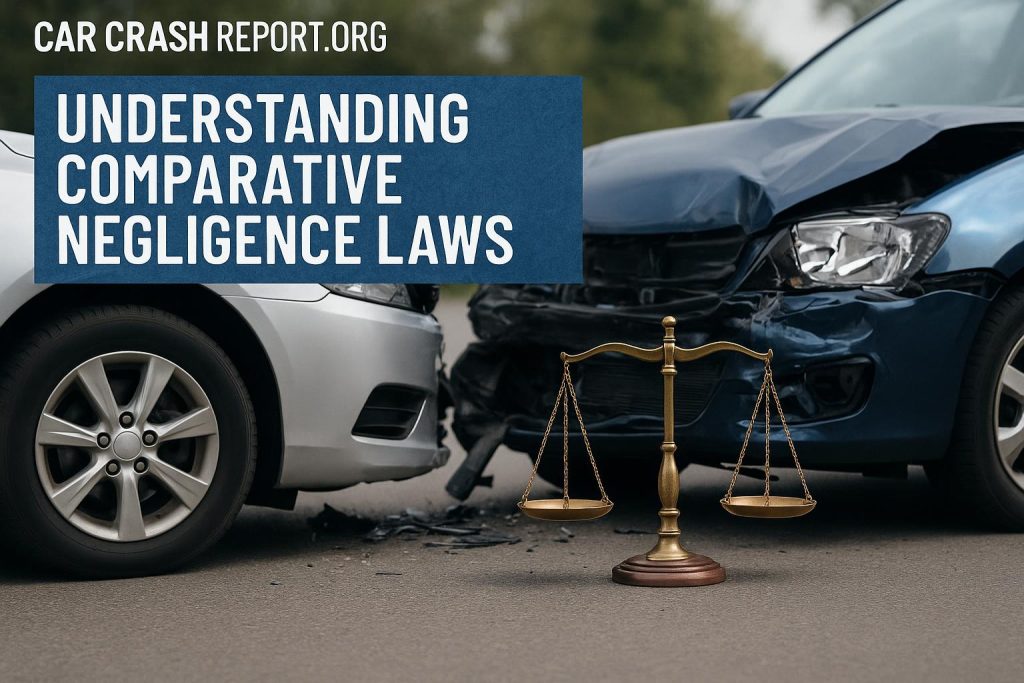
Car Crash Report Org is a Dallas, Texas-based organization that provides accident victims and their families with access to verified crash data and documentation. Car Crash Report Org compiles information from sources such as police reports, DMV records, and traffic databases, offering secure and accessible reports that support insurance claims and legal processes. Its platform allows users to search by name, date, VIN, or location, helping individuals obtain relevant records efficiently. In addition to documentation services, the organization publishes The Crash Reporter, which covers developments in traffic safety law and insurance practices. Through its data resources and educational content, Car Crash Report Org helps explain legal concepts such as comparative negligence, which plays a central role in determining fault and compensation following vehicle accidents.
Understanding Comparative Negligence Laws
Established in 2003, Car Crash Report Org is a trusted accident victim advocate committed to helping accident victims and their families in the aftermath of vehicle crashes. Among various services, Car Crash Report Org (carcrashreport.org) operates The Crash Report, a journalism platform that provides motorists with data-driven analytics and articles about emerging traffic trends and insurance options.
When it comes to learning about different insurance policies and coverage options, American drivers must understand the difference between pure comparative fault, modified comparative fault, and pure contributory negligence laws. These approaches to fault play a role in determining liability following a vehicle collision and, more importantly, which driver must pay and how much.
State lawmakers determine fault laws, not insurance companies, though insurance providers can help drivers understand relevant legislation and to develop corresponding insurance plans. Pure contributory negligence is the strictest type of comparative negligence, and it is only observed in the states of Alabama, Maryland, North Carolina, and Virginia, along with Washington, DC. Under pure contributory negligence laws, if any vehicle operator involved in an accident shares any blame for the accident, the law prohibits them from seeking damages or compensation. This means that even if another driver flagrantly broke multiple traffic laws and assumes 99 percent of fault for the accident, if court officials and law enforcement officers determine that the aggrieved party shares 1 percent of fault, they cannot collect damages.
Modified comparative fault, on the other hand, is the most common type of comparative negligence system. More than 30 states operate with modified comparative fault laws, though states can implement either the 50 percent bar rule or the 51 percent bar rule. In states with the 50 percent bar rule, injured parties can only collect damages if they are less than 50 percent at fault for an accident, and their percentage of fault dictates how much money they can recover from other drivers. If a person is at least 50 percent to blame for an accident, they cannot seek damages. The 51 percent modified comparative negligence standard slightly amends this approach, allowing drivers to seek compensation even if they are 50 percent at fault for an accident.
Pure comparative fault occupies a middle ground between pure contributory negligence and modified comparative fault. New York, Rhode Island, South Dakota, New Mexico, and California are a few of the 13 states that recognize pure comparative fault laws. If a person is injured in a car accident in one of these states, they can seek damages from other drivers even if they assume the majority of fault for the accident, meaning a person can receive compensation even if they are 99 percent to blame for the accident.
However, pure comparative fault states award damages based on a person’s percentage of fault. As an example, if a driver is involved in an accident and racks up $50,000 in damages, they can initiate insurance claims processes. If insurance companies and authorities determine the driver is 50 percent at fault for the accident, they can only receive up to $25,000.
When signing up for car insurance and determining what type of coverage to get, drivers must understand how their state calculates fault and awards damages. Regardless of the comparative negligence system, drivers should always observe safe driving habits and do everything in their power to minimize the risk of accidents while on the road.
About Car Crash Report Org
Car Crash Report Org is an organization based in Dallas, Texas that provides free access to official crash reports and related data across all 50 states. Its platform delivers secure, encrypted access to police reports, DMV records, and traffic data to support insurance and legal processes. The organization also publishes The Crash Reporter, offering insights into traffic safety law and insurance trends while advocating for transparency, fairness, and informed decision making for accident victims.